Oregon's Spring Tax Lull Ends

The Takeaway
After a fairly quiet spring, this week ended the lull for tax and revenue issues in Oregon with the release of the latest quarterly revenue forecast and the near-final returns from the state’s primary election. Together, they put tax and revenue policy back at the center of Oregon’s political conversation for the general election campaign and, more consequentially, the 2027 legislative session.
State Revenues Artificially Stabilized
On Wednesday, lawmakers on the tax-writing committees were told by state economists that Oregon’s anticipated revenues increased by $345 million since the last forecast in February. The framing of “revenues up” obscures the reality the state faces — its economy and the public revenues it generates are teetering on a downward trajectory.
The economists attributed the new revenues not to economic growth — in fact, the state is stagnating on most economic indicators — but rather legislative action. During this year’s short session, the legislature disconnected Oregon from several provisions of H.R. 1, the “One Big Beautiful Bill,” as it relates to a new deduction on car loan interest, favorable expensing rules for businesses, and a tax exclusion for ownership interest in a startup. Those policies increased state revenues by $368 million. Absent the legislature denying those policies, lawmakers would find the state facing a negative biennial ending balance.
It is easy to see headlines about Oregon’s positive revenue growth as a good story, but the economic backdrop is becoming less favorable. Over the last year, Oregon’s growth has trailed the nation by 1.1 percentage points. The state’s unemployment rate is 5.2 percent, compared with a national rate of 4.3 percent. And year-over-year payroll growth is negative — a condition the state has only experienced during recessions.
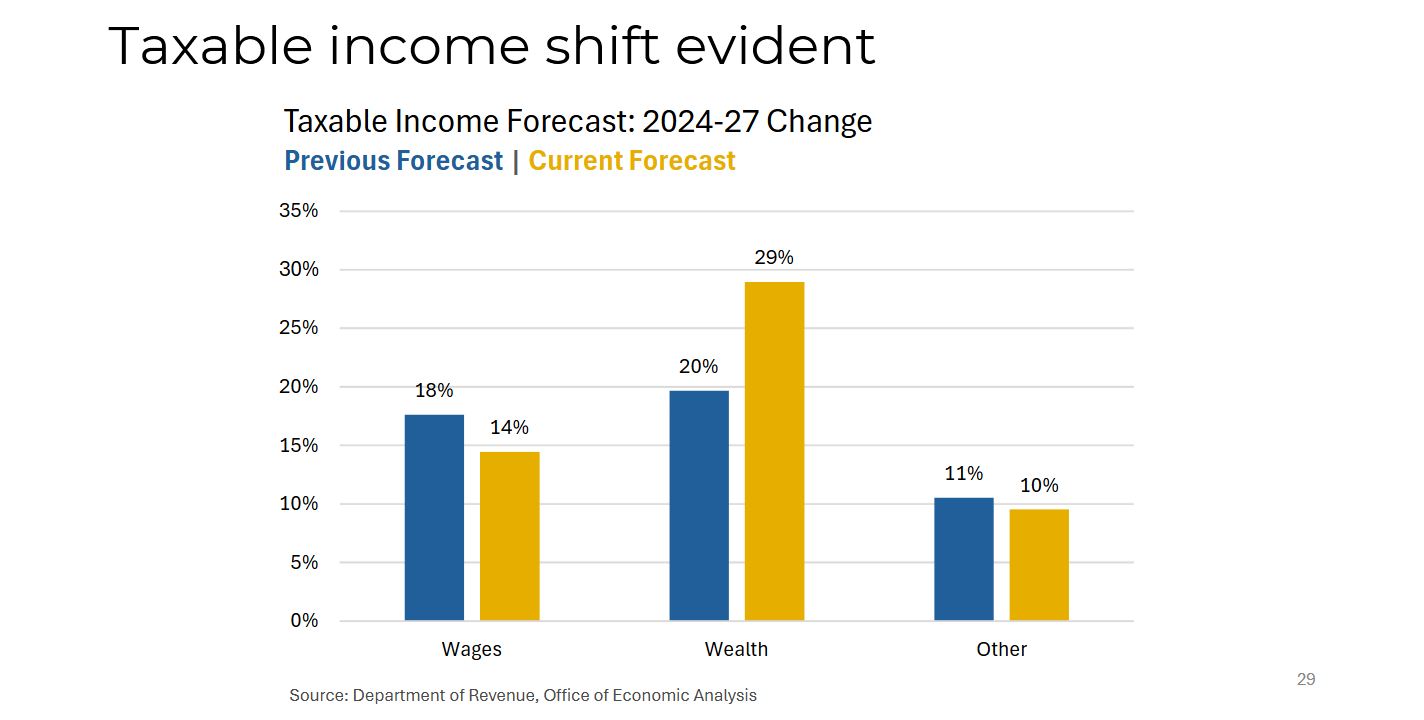
One reason the dismal economic performance is not further deteriorating revenues is a shift in the composition of taxable income. Oregon is seeing significantly weaker wage growth and, therefore, wage-related tax collections, while market-driven sources, like capital gains, dividends, and business income, have grown faster. Since investment income is significantly more volatile than payroll, there is more uncertainty on the state’s revenue and budget outlook. Oregon’s budget outlook is increasingly leveraged to equity markets — a structural feature that pays well in good years and bills hard in bad ones.
The fiscal challenges facing Oregon are not visible in a single forecast. Over the last decade, revenues grew substantially (largely due to a policy preference for increasing and expanding taxes), spending grew buoyed by one-time money, and the federal government contracted its role in safety net programs. The room for Oregon to absorb the next downside surprise, whether it arrives as a recession, a market correction, or any other factor, is narrow.
Transportation Funding's Predictable Demise
Early results from Tuesday’s primary election show a mixed sentiment from voters. Oregonians rejected the partisan transportation funding referendum by wide margins, set into motion a gubernatorial rematch between Gov. Tina Kotek (D) and Sen. Christine Drazan (R), and nominated two Democratic Socialists to the general election. Additionally, local funding measures in many areas struggled relative to their historical norms.
The saga around Oregon’s transportation funding package has been among the most tumultuous and controversial local tax stories of the last 18 months. During a 35-day special session last fall, Democrats delivered a party-line package of unpopular tax increases that were ultimately referred to voters by a Republican signature-gathering campaign. During this year’s short session, Democrats moved the referendum from the general election to the primary election to avoid creating headwinds in an otherwise favorable midterm landscape.
Unsurprisingly, Oregonians resoundingly rejected the transportation referendum by a margin of 82.96 percent to 17.04 percent, resetting the legislative dialogue. Usually, a controversial tax ballot measure draws strong, well-funded campaigns on both sides. In this case, however, there was neither. Lawmakers wrote off the referendum as a failure the moment enough signatures were collected, and practically no resources were deployed to defending the package. Oregonians have a history of supporting tax measures when they are presented as thoughtful, but there was no real effort to present this one that way.
These distinctions matter because the result will likely be cited, fairly or not, as evidence that Oregon voters are turning sour on taxes. Such claims are perhaps too sweeping of a conclusion to draw from a single race in which one side simply did not show up.
Democratic Socialists Make Big Gains in Democratic Primaries
The more politically consequential story from the primary may be the one unfolding within Oregon’s Democratic majority. The party is now in the early stages of an internal contest between center-left, pragmatic progressives and a self-described socialist wing that has been gaining institutional traction. The May primary delivered the socialists with consequential wins.
In Senate District 15, encompassing the greater Hillsboro area, Sen. Janeen Sollman — a ten-year legislative veteran — lost to political newcomer Myrna Munoz, an educator, by 51.54 to 45.93 percent. Sen. Sollman outspent Munoz roughly two-to-one in a race that was one of the most expensive primary campaigns this cycle. The primary challenge was driven by an unusual partnership between the state’s heavyweight public employee unions and the local chapter of the Democratic Socialists of America.
In House District 27 in greater Beaverton, Democratic Socialist and Beaverton school board member Tammy Carpenter defeated Beaverton City Councilor Ashley Hartmeier-Prigg, 52.08 to 47.62 percent for an open seat. Like the Sollman-Munoz race, Carpenter received substantial backing from the public employee unions and far-left groups. In both races, the more moderate candidate led in election night returns and gradually lost ground as later-arriving ballots, which history suggests are from younger and less-frequent voters, were counted.
For Local Funding Measures, Trust Matters
Across the state, voters were asked to decide the fate of 70 local funding measures, passing 44 and rejecting 26. Oregonians have historically supported local funding measures at roughly a 70 percent pass rate. For this cycle, that rate softened to 63 percent — more still passed than failed, but a notable drop in the success rate.
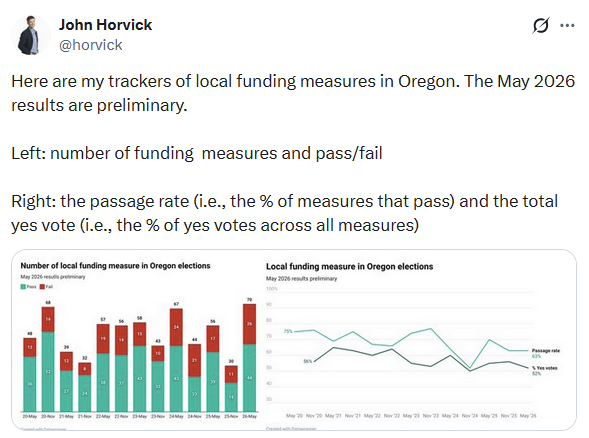
It is tempting — and journalistically convenient — to read the primary as a referendum on whether Oregonians support higher taxes. That framing seems to miss the mark. Oregonians have a long track record of approving tax and bond measures when they are presented with credible campaigns, well-articulated needs, and demonstrable accountability. Voters rejected a local option levy for Canby schools, a new public works building in Tigard, and a striking number of public safety levies which usually prevail. Among the 33 public safety levies on the ballot, only 18 were approved.
The failure of the Tigard public works levy illustrates this point. The City has now tried multiple times to secure funding for a new public works facility, sometimes presented on its own merits and sometimes packaged with other public safety funding. When voters perceive that an elected body is repeatedly returning with the same request under shifting labels, they develop a trust deficit with their elected officials. Oregonians are willing to fund the services they want but are less willing to fund services they suspect they are being maneuvered into.
The Primary’s Lasting Impact on Oregon Tax Politics
With the primary now behind us, the relative calm on tax and revenue issues seems to be concluding. The political coalitions that will shape the 2027 session are demonstrably different than those that shaped the 2025 session. The willingness for powerful groups within the Democratic coalition to target a progressive lawmaker and replace them with a socialist gives the legislature’s left flank leverage it did not have a year ago. There are already rumors of Democrats targeting a sales tax, pursuing a wealth proceeds tax, and jettisoning taxes on global companies. While the primary election does not influence the balance of power in the legislature, it tips the scales within the platoons that will soon dominate legislative politics.