State Revenues Unremarkably Stable, Increase for 2027-29
State economists told lawmakers on the tax-writing committees that Oregon’s economy is showing “signs of life and expansion.” The state’s economy grew 2.4 percent over the last year, closing in on the national growth rate, a marked improvement from the gap that defined the state’s post-pandemic recovery. The economists also put the odds of a national recession at 18 percent, the lowest reading in this cycle and down from 22 percent three months ago, attributing the low chance to easing tariffs (and refunds) largely balancing out the energy price shock from geopolitical conflicts.
In recent forecasts, the economists routinely analogize the state’s economic outlook as a “hockey stick,” where job and investment trends remain flat before shooting upward in a near-vertical line. However, it remains to be seen if we are at a turning point or a temporary convergence. In other words, will energy price shocks and interest-rate risks zap or delay a rebound toward real growth? Oregon’s unemployment rate has stubbornly held at 5.2 percent, nearly a full point above the national rate, despite the latter trending downward. According to data published by the Oregon Employment Department this week, employment grew in Salem, Bend, Grants Pass, and Medford, while it declined in Portland, Eugene, Corvallis, and Albany.
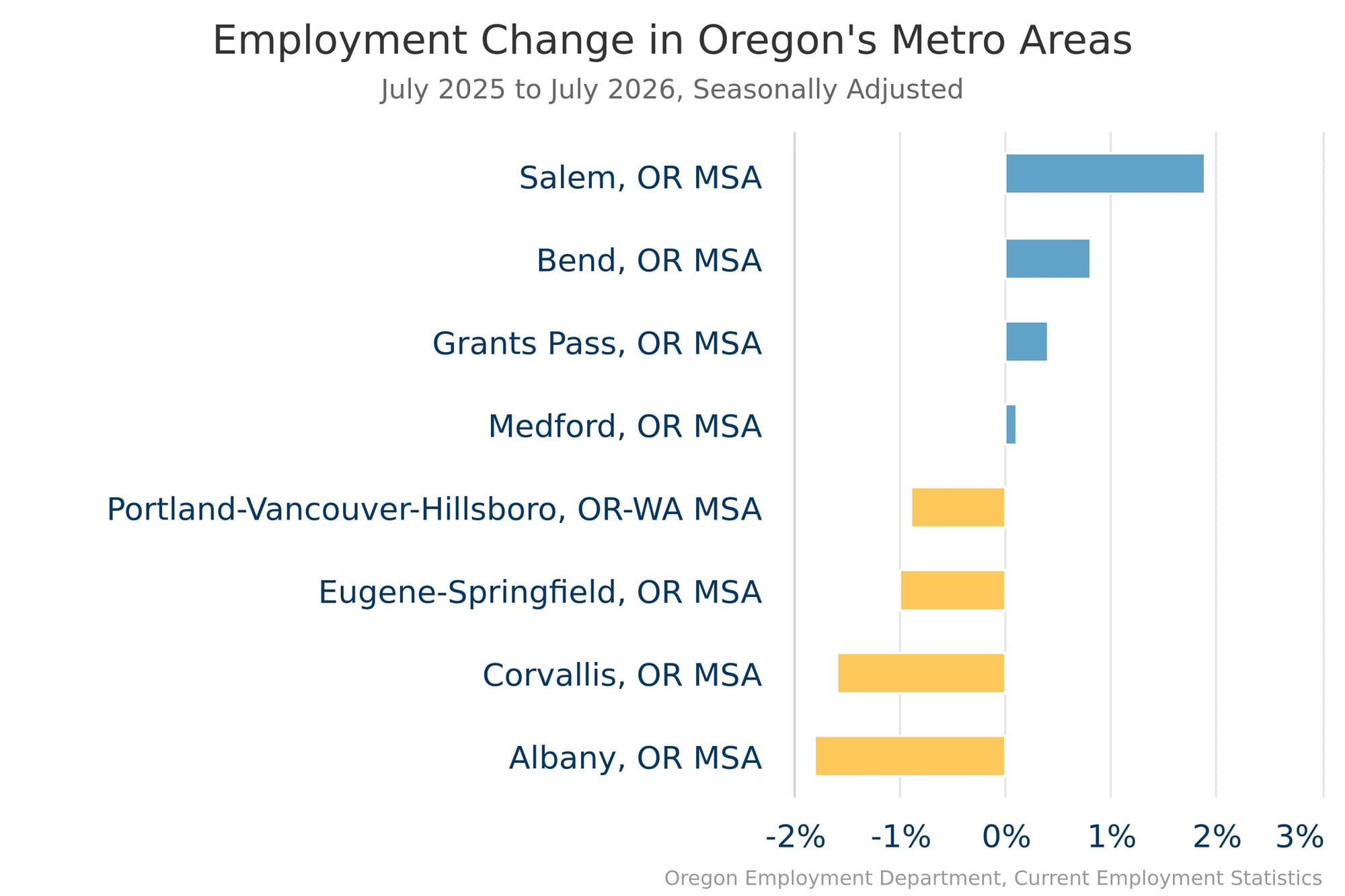
The labor market indicators suggest an inverse of the economy that drove the state’s growth during the 2010s, in which the major metropolitan centers revved their employment engines while rural regions stalled. It is unequivocally good news to see growth outside the metro areas; however, the state’s regionally concentrated population means that no amount of growth elsewhere can carry the state in the same way.
Inflation Is Taxation Without Legislation
The economists characterized the economy as reaching an inflection point — transitioning from one paradigm (slowing) to another (accelerating), with economic indicators becoming noisier and the consequences generally marginal. As such, the revenue picture for this forecast is nominally raised by $55 million in additional resources for the current biennium and by $593 million for the 2027-29 biennium.
While the state is not regaining ground in the labor market, its personal income tax withholdings are running well ahead of expectations. The revenue forecast now projects roughly six percent growth this year, up from 4.5 percent assumed only three months ago. Oregon collects an average of $1 billion per month from withholdings, so a one-and-a-half point upward revision adds up fast.
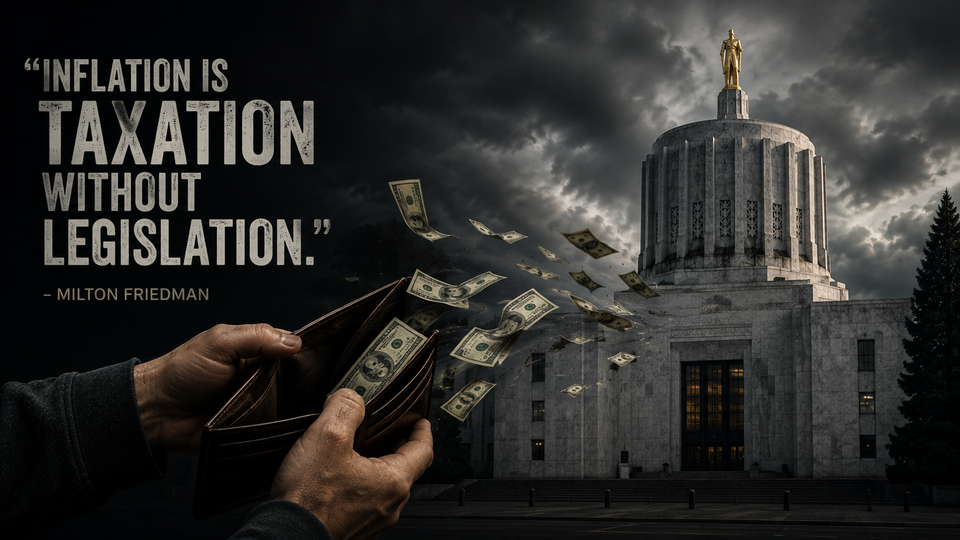
In their written forecast, the economists cite Milton Friedman, who quipped, “Inflation is taxation without legislation.” This forecast is a live demonstration, especially since the state’s income tax is only loosely indexed to inflation. (The state’s highest personal income tax rate of 9.9 percent applies to taxable incomes over $125,000 — a number that has not been adjusted since the rate was created in 2010.) As employers raise nominal wages to keep pace with inflation, those wages flow through Oregon’s tax tables and into the treasury without any recognition of their inflationary growth.
Meanwhile, the corporate income tax projections tell a vastly different, and likely noisier, story, with collections revised downward by $96 million. Unlike the personal income tax, the corporate tax is highly volatile because a small number of payers account for the lion’s share of total collections (nearly $3.5 billion over the biennium). Historically, when a corporation overpays, 95 percent of the time they choose to let the refund ride forward as a credit against their next estimated payment. Right now, however, that percentage is only 60 percent. In their presentation to lawmakers, the economists characterized this behavior as a timing anomaly that should wash out in future quarters.
The throughline of the state's revenue position is less reassuring than it appears. At a time when most other states are experiencing real revenue growth, Oregon's growth is only nominally up — a stability manufactured by wage inflation and taxes lawmakers raised during the short session. It fails to reflect the real economy, which is struggling to grow.